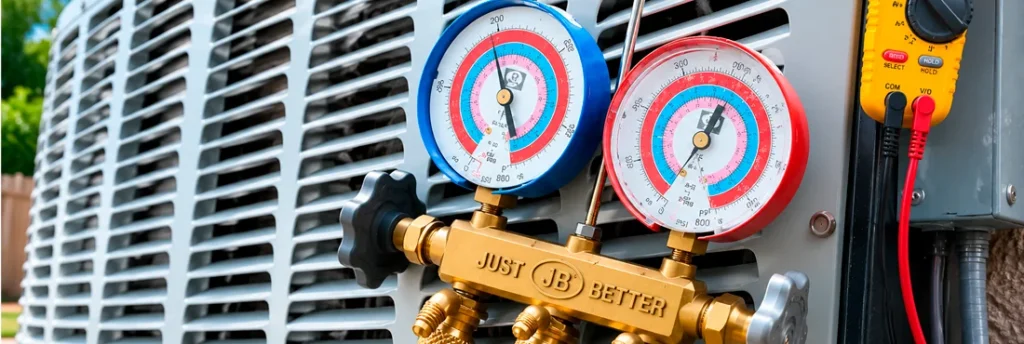
AC refrigerant types play an important role in how efficiently and reliably your air conditioning system operates.
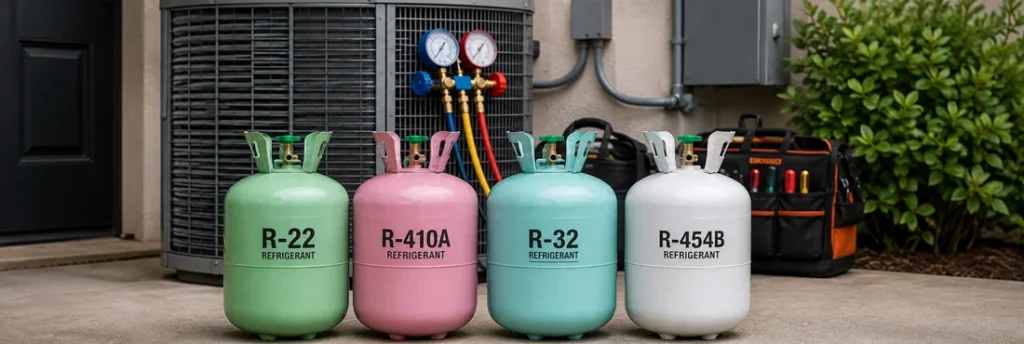
Older and newer air conditioning systems can use very different refrigerants. R-22 was common in older equipment, R-410A became widely used for many years, and newer HVAC equipment is increasingly being designed around lower-global-warming-potential refrigerants such as R-32 and R-454B.
Understanding these differences can help homeowners make more informed decisions about AC repair, refrigerant service, and HVAC replacement.
Is Your AC Not Cooling Properly?
If your air conditioner is blowing warm air, freezing up, running continuously, or showing other signs of a possible refrigerant problem, professional diagnosis should come before simply adding refrigerant.
Call ARD Engineering Group today at (818) 488-0703 for professional AC diagnostics, refrigerant service, repair, or HVAC replacement in Los Angeles and surrounding areas.
Our technicians can inspect the system and determine whether the problem involves refrigerant, airflow, electrical components, the compressor, or another part of your HVAC equipment.
What Does Refrigerant Do in an AC System?
Refrigerant is the substance that allows an air conditioning system to transfer heat.
An air conditioner does not technically “create” cold air. Instead, it removes heat from inside the home and transfers that heat outdoors.
Refrigerant circulates between the indoor and outdoor components of the system, changing pressure and temperature as it moves through the refrigeration cycle.
When the system is operating properly and contains the correct refrigerant charge, this process continuously removes heat from the indoor air.
If refrigerant escapes because of a leak or another refrigeration-system problem develops, cooling performance can decline significantly.
Common Refrigerants Used in Residential Air Conditioning
The refrigerant used by an air conditioning system depends primarily on the age and design of the equipment.
Some older systems still operate with refrigerants that are no longer used in new HVAC equipment, while newer systems are being designed around refrigerants that meet updated environmental requirements.
R-22 Refrigerant
R-22, also commonly associated with the trade name Freon, was widely used in residential air conditioning systems for decades.
R-22 is an HCFC refrigerant that contributes to ozone depletion. Because of its environmental impact, production and import of new R-22 in the United States ended in 2020.
However, this does not mean homeowners are legally required to replace an existing R-22 air conditioner.
According to the U.S. Environmental Protection Agency, existing R-22 equipment can continue to be serviced using recovered, reclaimed, or previously produced refrigerant.
The practical question for homeowners is usually whether repairing an older R-22 system still makes financial sense.
If an aging system develops an expensive refrigerant leak, compressor failure, or coil problem, it may be worth comparing the repair cost with the cost of replacing the equipment.
R-410A Refrigerant
R-410A became one of the most common refrigerants in residential air conditioning following the transition away from R-22.
Unlike R-22, R-410A does not contain chlorine and does not have the same ozone-depletion problem.
However, refrigerant regulations have continued to evolve.
R-410A has a relatively high global warming potential, and the HVAC industry is transitioning toward alternatives with substantially lower GWP.
EPA’s current Technology Transitions rules restrict higher-GWP HFCs in various types of new air-conditioning and heat-pump equipment, which is one reason homeowners purchasing new systems are increasingly seeing alternatives such as R-32 and R-454B.
Importantly, having an existing R-410A system does not automatically mean that it needs to be replaced.
R-32 Refrigerant
R-32 is one of the lower-GWP refrigerants being used in newer air conditioners and heat pumps.
Compared with R-410A, it has a substantially lower global warming potential while providing effective heat-transfer characteristics.
R-32 is classified as an A2L refrigerant.
The A2L classification indicates lower toxicity and mild flammability under applicable refrigerant safety classifications.
Because of these characteristics, HVAC equipment designed for R-32 incorporates specific design, installation, and servicing requirements.
This is important for homeowners to understand: R-32 is not simply a replacement refrigerant that should be added to an existing R-410A system.
The equipment must be specifically designed and approved for the refrigerant it uses.
R-454B Refrigerant
R-454B is another lower-GWP refrigerant being adopted in newer residential HVAC systems.
Like R-32, it is classified as an A2L refrigerant and requires equipment designed specifically for its characteristics.
As HVAC manufacturers transition toward lower-GWP equipment, homeowners purchasing a new air conditioner or heat pump may increasingly see R-454B listed on equipment specifications.
The change does not mean that R-454B should be placed into an older R-410A or R-22 system.
Each HVAC system is engineered around a specific refrigerant.
R-22 vs. R-410A vs. R-32 vs. R-454B
The major differences between these refrigerants involve their environmental characteristics, equipment compatibility, operating requirements, and the generations of HVAC equipment in which they are commonly found.
| Refrigerant | Common Application | General Status |
|---|---|---|
| R-22 | Older AC systems | No new U.S. production/import; existing systems can still be serviced |
| R-410A | Many existing residential AC and heat-pump systems | Widely present in existing equipment; newer equipment is transitioning away from higher-GWP refrigerants |
| R-32 | Newer AC and heat-pump systems | Lower-GWP A2L refrigerant |
| R-454B | Newer AC and heat-pump systems | Lower-GWP A2L refrigerant |
For homeowners, the most important point is that the refrigerant must match the equipment for which the system was designed.
Can Different AC Refrigerants Be Mixed?
No. Refrigerants should not be treated as interchangeable.
An HVAC system is engineered for a specific refrigerant. Its design takes into account factors such as:
- Operating pressures
- Compressor design
- Refrigerant metering components
- Lubricants
- Heat exchangers
- Safety requirements
- Controls and sensors
Adding a different refrigerant without an approved system design or properly engineered conversion can result in poor performance, equipment damage, and potentially unsafe operating conditions.
The correct refrigerant type can normally be found on the manufacturer’s data plate located on the equipment.
Does Low Refrigerant Mean Your AC Just Needs a Recharge?
Not necessarily.
This is an important misconception about residential air conditioning.
A properly sealed AC system does not normally “consume” refrigerant like a vehicle consumes gasoline.
Refrigerant continuously circulates through the system.
If the refrigerant charge becomes significantly low, there may be a leak somewhere in the refrigeration circuit.
Simply adding more refrigerant may temporarily improve cooling without correcting the underlying problem.
Depending on the situation, a technician may need to locate the leak, evaluate the affected components, repair the problem, and then restore the correct refrigerant charge.
Common Signs of a Refrigerant Problem
Several symptoms can occur when an AC system has an incorrect refrigerant charge or refrigerant leak.
Possible signs include:
- AC running but not cooling properly
- Warm or insufficiently cool air from vents
- Longer-than-normal cooling cycles
- Ice or frost on the evaporator coil
- Ice on refrigerant lines
- Hissing sounds near refrigerant components
- Increased electricity consumption
- Difficulty reaching the thermostat setting
- System running almost continuously
However, these symptoms do not automatically mean the system is low on refrigerant.
Restricted airflow, dirty coils, electrical problems, compressor issues, thermostat problems, and other HVAC failures can produce similar symptoms.
That is why proper diagnosis should come before adding refrigerant.
What Causes AC Refrigerant Leaks?
Refrigerant leaks can develop in different parts of an HVAC system.
Possible locations include:
- Evaporator coil
- Condenser coil
- Refrigerant lines
- Service valves
- Fittings and connections
- Brazed joints
- Other refrigeration components
Leaks can result from corrosion, vibration, physical damage, deteriorated components, installation problems, or normal equipment aging.
Finding the actual source is important because repeatedly adding refrigerant without addressing the leak may result in the same problem returning.
Should You Repair or Replace an Older Refrigerant System?
There is no single answer that applies to every air conditioner.
A relatively new system with an accessible and repairable leak may be worth repairing.
An older system requiring an expensive compressor, coil, or major refrigerant repair may be a different situation.
Before deciding, consider:
- Age of the air conditioner
- Refrigerant type
- Location and severity of the leak
- Compressor condition
- Coil condition
- Estimated repair cost
- Overall equipment efficiency
- Previous repair history
- Availability of replacement parts
- Remaining warranty coverage
The goal should be to compare the cost and expected life of the repair with the long-term value of replacing the equipment.
Should You Replace an R-22 Air Conditioner?
Not simply because it contains R-22.
EPA does not require homeowners to replace existing R-22 air-conditioning systems, and those systems can continue to be serviced with available reclaimed or previously produced R-22.
However, equipment using R-22 is generally older.
If an R-22 system develops a major failure, the combination of equipment age, repair cost, refrigerant considerations, and efficiency may make replacement more attractive.
A small repair and a major compressor or coil failure should therefore be evaluated very differently.
What Refrigerant Should a New AC System Use?
Homeowners generally should not select an HVAC system based only on refrigerant type.
Refrigerant is important, but so are:
- Equipment efficiency
- Correct system capacity
- Compressor technology
- Indoor equipment compatibility
- Ductwork
- Electrical requirements
- Installation quality
- Warranty
- Manufacturer support
New equipment designed around refrigerants such as R-32 and R-454B incorporates the components and safety features required for those refrigerants.
When comparing new HVAC systems, ask the contractor which refrigerant the equipment uses and what that means for installation and future servicing.
Why Professional Refrigerant Service Matters
Refrigerant work is very different from basic homeowner HVAC maintenance.
Proper diagnosis may involve:
- Measuring system pressures
- Checking temperatures
- Evaluating superheat and subcooling where applicable
- Inspecting coils
- Testing refrigerant lines
- Performing leak detection
- Checking airflow
- Evaluating compressor operation
- Inspecting electrical components
Technicians servicing regulated refrigerants must also follow applicable EPA requirements for refrigerant handling and recovery. EPA specifically advises homeowners to use technicians with the appropriate Section 608 certification when servicing equipment containing regulated refrigerants.
If an AC repeatedly loses cooling capacity or repeatedly needs refrigerant, identifying the actual cause is more important than simply adding another charge.
AC Refrigerant Service in Los Angeles
Air conditioning systems in Los Angeles can operate for extended periods during hot weather. When cooling performance begins to decline, finding the actual cause early can help prevent unnecessary repairs and prolonged discomfort.
If your AC is blowing warm air, developing ice on refrigerant lines, showing signs of a possible refrigerant leak, or requiring repeated service, ARD Engineering Group can inspect the system and determine the appropriate repair options.
The problem may involve refrigerant, but it may also involve airflow, electrical components, coils, the compressor, or another part of the HVAC system.
Call ARD Engineering Group at (818) 488-0703 for professional AC repair, refrigerant diagnostics, maintenance, and HVAC replacement in Los Angeles and surrounding areas.