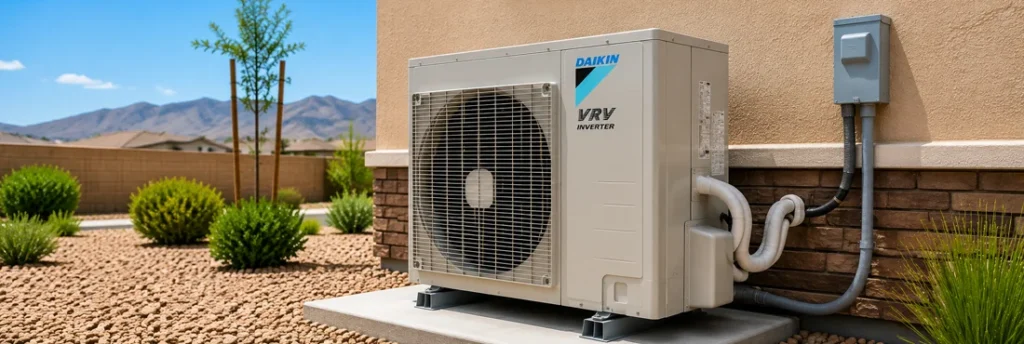
Daikin heat pump installation in Victorville can provide homeowners with efficient heating and cooling from a single system while supporting year-round home comfort.
For homeowners considering an HVAC upgrade, a modern Daikin heat pump can provide both cooling and heating from a single system. Daikin offers inverter-driven and variable-speed options designed to adjust their operation according to the home’s heating and cooling needs.
For homeowners in Victorville, California, choosing the right heat pump is only part of the process. Proper sizing, airflow, electrical requirements, equipment configuration, and professional installation all contribute to reliable long-term performance.
Ready to Upgrade Your Home Comfort?
Considering a Daikin heat pump for your home? Call ARD Engineering Group today at (818) 488-0703 to discuss your HVAC needs and find the right heating and cooling solution for your home.
What Is a Daikin Heat Pump?
A heat pump is an HVAC system capable of both cooling and heating a home.
During warmer weather, it operates similarly to a conventional air conditioner by removing heat from inside the house and transferring it outdoors.
When heating is needed, the refrigeration cycle reverses. Instead of removing heat from the home, the system extracts available heat from the outdoor air and transfers it indoors.
This allows one HVAC system to provide year-round temperature control without requiring separate conventional air conditioning and heating equipment for its primary operation.
Why Consider a Daikin Heat Pump?
Modern Daikin heat pump systems are available with features designed to improve comfort, efficiency, and system control.
Depending on the model and configuration, potential advantages may include:
- Heating and cooling from one system
- Inverter-driven or variable-speed operation
- More consistent indoor temperatures
- Quieter operation compared with some traditional systems
- Reduced start-and-stop cycling
- Smart control options
- High-efficiency equipment choices
- Multiple residential system configurations
The right system depends on the property, existing HVAC equipment, ductwork, electrical capacity, and the homeowner’s comfort requirements.
How Variable-Speed Heat Pumps Work
Traditional single-stage HVAC equipment typically operates at full capacity whenever heating or cooling is required.
Variable-speed and inverter-driven heat pumps operate differently.
Instead of repeatedly switching between completely on and completely off, the compressor can adjust its output according to current demand.
For example, during moderately warm weather, the system may not need to operate at maximum capacity. It can run longer at a lower output to maintain the desired indoor temperature.
As outdoor temperatures increase and cooling demand becomes greater, the system can increase its output.
This type of operation can help maintain more consistent indoor temperatures while reducing frequent start-and-stop cycles.
Why Proper Heat Pump Sizing Matters
One of the most important parts of heat pump installation is selecting equipment with the appropriate capacity.
A larger HVAC system is not automatically better.
An oversized heat pump may:
- Turn on and off too frequently
- Create uneven temperatures
- Operate less efficiently
- Increase unnecessary equipment wear
- Reduce overall indoor comfort
An undersized system, on the other hand, may struggle to maintain the desired temperature during periods of high heating or cooling demand.
Professional HVAC installation should include an evaluation of the home’s actual heating and cooling requirements rather than simply replacing old equipment with a new system of the same nominal size.
What Is Involved in Daikin Heat Pump Installation?
Installing a heat pump involves much more than placing an outdoor unit next to the house.
The exact process depends on the existing HVAC system, the property, and the equipment being installed.
1. Evaluating the Existing HVAC System
Before installation begins, the existing equipment should be inspected.
The evaluation may include:
- Existing air conditioner or heat pump
- Furnace or air handler
- Ductwork
- Refrigerant lines
- Electrical service
- Thermostat and controls
- Condensate drainage
- Available installation space
This helps determine which components can remain and which may need replacement or modification.
2. Removing Existing Equipment
When replacing an older HVAC system, the existing indoor and outdoor equipment may need to be disconnected and removed.
Refrigerant must be handled correctly, and electrical and mechanical connections need to be safely disconnected.
The installation areas can then be prepared for the new equipment.
3. Installing the Outdoor Heat Pump
The outdoor heat pump needs a stable installation location with sufficient clearance for airflow and future service access.
Correct positioning is important because restricted airflow around the outdoor coil can negatively affect performance.
The equipment must also be properly secured and connected to the refrigerant and electrical systems.
4. Installing the Indoor Equipment
Depending on the configuration, a Daikin heat pump may be paired with an air handler or other compatible indoor equipment.
Correct airflow across the indoor coil is essential.
Improper airflow can affect:
- Cooling performance
- Heating performance
- Energy efficiency
- Refrigerant operation
- Equipment reliability
For this reason, the existing ductwork should also be evaluated as part of the installation process.
5. Refrigerant Line Installation and Testing
Refrigerant lines connect the indoor and outdoor components of the HVAC system.
These lines must be properly sized, connected, insulated, evacuated, and tested.
Problems with refrigerant piping or system preparation can reduce performance and potentially contribute to future equipment problems.
6. Electrical Connections
Heat pumps require properly sized electrical circuits and appropriate protection.
Depending on the new equipment and the home’s existing electrical system, installation may involve:
- Dedicated electrical circuits
- Disconnects
- Circuit breakers
- Wiring modifications
- Electrical panel evaluation
If the existing electrical system cannot safely support the new HVAC equipment, additional electrical work may be required.
7. Thermostat and System Controls
Modern heat pump systems may use advanced controls to manage compressor operation, fan speed, heating, cooling, and other functions.
Correct configuration is especially important for variable-speed equipment.
After installation, the controls should be configured according to the equipment requirements and the home’s comfort needs.
What About the Existing Ductwork?
Installing high-efficiency HVAC equipment does not automatically solve problems caused by damaged or poorly designed ductwork.
Before or during heat pump replacement, the duct system may need to be evaluated for:
- Air leaks
- Damaged duct sections
- Poor insulation
- Restricted airflow
- Incorrect duct sizing
- Disconnected ducts
- Uneven air distribution
If conditioned air escapes into an attic, garage, or another unconditioned area, even efficient HVAC equipment may struggle to provide the expected comfort and performance.
Repairing duct problems can therefore be an important part of an HVAC upgrade.
Can a Heat Pump Replace Both AC and Heating?
In many homes, yes.
A heat pump can provide air conditioning during warm weather and heating during cooler periods.
Whether a heat pump should completely replace an existing heating system depends on several factors, including:
- Property characteristics
- Existing HVAC configuration
- Climate conditions
- Electrical capacity
- Heating requirements
- Homeowner preferences
Some homes use a heat pump as the primary heating and cooling system, while others may use supplemental or dual-fuel heating configurations.
Heat Pumps and Energy Efficiency
Heat pumps transfer heat rather than generating all heating energy through electric resistance.
This operating principle can make them an efficient option for many residential applications.
However, actual energy consumption depends on more than the efficiency rating printed on the equipment.
Other important factors include:
- Home insulation
- Window condition
- Duct leakage
- Thermostat settings
- Outdoor temperature
- Equipment sizing
- Installation quality
- Maintenance
- Household usage patterns
For this reason, purchasing high-efficiency equipment is only one part of creating an efficient HVAC system.
Why Installation Quality Matters
Even high-quality HVAC equipment can perform poorly if it is installed incorrectly.
Installation problems can affect comfort, efficiency, reliability, and equipment lifespan.
Potential problems include:
- Incorrect equipment sizing
- Improper refrigerant charge
- Poor airflow
- Incorrect electrical connections
- Leaking ductwork
- Improper condensate drainage
- Incorrect thermostat configuration
- Insufficient clearance around the outdoor unit
After installation, the system should be properly started, configured, and tested to confirm that it is operating as intended.
When Should You Consider Replacing Your Existing HVAC System?
Not every older HVAC system needs immediate replacement.
However, replacement may be worth considering when:
- Repairs are becoming increasingly frequent
- Major components are beginning to fail
- The system struggles to maintain comfortable temperatures
- Energy consumption has noticeably increased
- Heating or cooling is uneven throughout the home
- The equipment is approaching the end of its expected service life
- You want one system capable of both heating and cooling
- You are making other major energy-efficiency improvements to the property
The condition of the entire HVAC system should be considered rather than focusing only on the age of one component.
Maintaining a Daikin Heat Pump
Like other HVAC equipment, heat pumps require routine maintenance to continue operating properly.
Maintenance may include:
- Replacing or cleaning air filters
- Keeping the outdoor unit free of debris
- Inspecting indoor and outdoor coils
- Checking condensate drainage
- Inspecting electrical components
- Checking system airflow
- Evaluating refrigerant operation
- Inspecting thermostat and control settings
Routine maintenance can also help identify developing problems before they turn into larger and more expensive repairs.
The condition of the entire HVAC system should be considered rather than focusing only on the age of one component.
Signs Your Heat Pump May Need Service
Even a properly installed heat pump can eventually require repair or maintenance.
Contact an HVAC professional if you notice:
- Unusual noises during operation
- Weak airflow from vents
- Unexpected increases in energy consumption
- Uneven heating or cooling
- Frequent system cycling
- Difficulty reaching the thermostat setting
- Ice developing where it normally should not
- Unusual odors
- The system repeatedly shutting down
Early diagnosis can sometimes prevent a relatively small issue from developing into a more expensive repair.
Professional Daikin Heat Pump Installation in Victorville, CA
Choosing the right heat pump involves more than selecting a brand or looking at an efficiency rating.
Equipment sizing, airflow, ductwork, refrigerant installation, electrical connections, controls, and final system testing all contribute to how well the HVAC system performs after installation.
ARD Engineering Group provides professional Daikin heat pump installation, HVAC replacement, repair, maintenance, and system diagnostics in Victorville and surrounding areas.
Whether you’re replacing an older air conditioner, experiencing problems with your current HVAC equipment, or considering a modern heat pump system, our team can help determine the right solution for your home.
Call ARD Engineering Group today at (818) 488-0703 to schedule an HVAC consultation and learn more about heat pump installation options for your home.