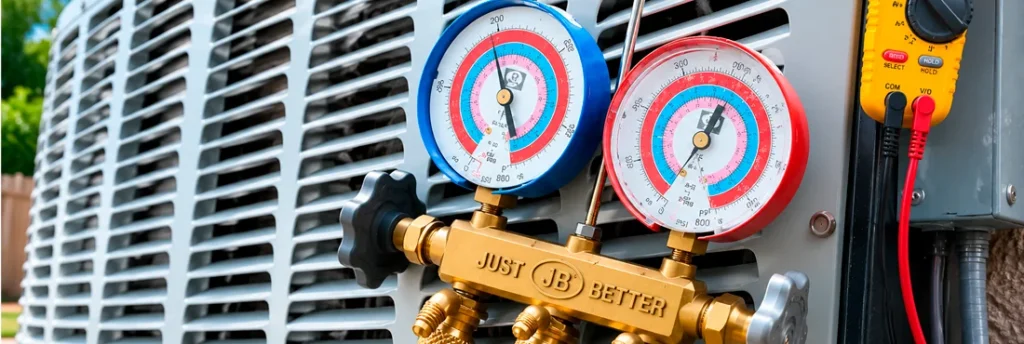
What does an AC compressor do? It circulates refrigerant and creates the pressure needed for your air conditioning system to remove heat from your home.
The compressor is one of the key parts of a central air conditioning system. Its job is to circulate refrigerant and create the pressure conditions necessary for the system to transfer heat from inside your home to the outdoors.
This is particularly important in warmer areas of Southern California, including Adelanto , where air conditioning systems can experience extended periods of operation during hot weather.
So what exactly does an AC compressor do, how does it work, and what are the warning signs that something may be wrong?
What Is an AC Compressor?
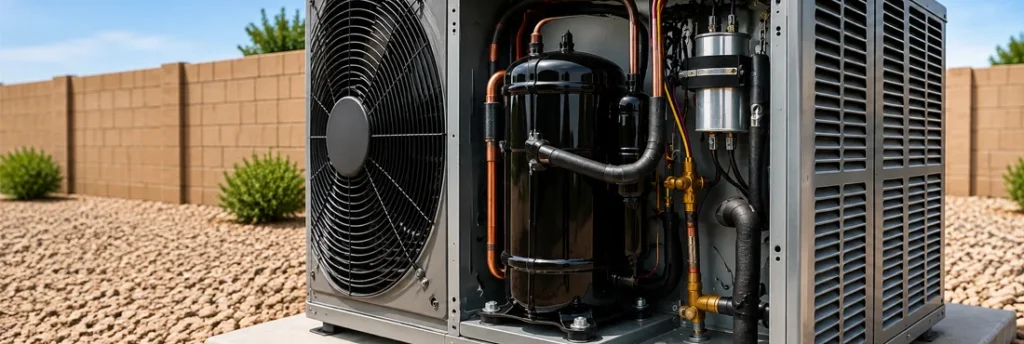
The AC compressor is located inside the outdoor condenser unit of most central air conditioning systems.
Its primary function is to compress and circulate refrigerant between the indoor and outdoor sections of the system.
Your air conditioner doesn’t technically create cold air. Instead, it removes heat from inside your home and transfers that heat outdoors.
Refrigerant carries this heat through the system, while the compressor maintains the pressure difference required for the refrigeration cycle to continue.
Without a properly functioning compressor, normal heat transfer and cooling cannot take place.
Why Hot Weather Can Put More Stress on an AC Compressor
During periods of high outdoor temperatures, an air conditioner may need to operate longer to maintain the desired indoor temperature.
Longer operating cycles aren’t necessarily a problem by themselves. However, existing issues such as dirty condenser coils, restricted airflow, incorrect refrigerant charge or failing electrical components can place additional stress on the compressor.
This is one reason preventive HVAC maintenance becomes especially important in hot, dry climates.
How Does an AC Compressor Work?
Understanding the basic refrigeration cycle makes the compressor’s role much easier to understand.
1. Refrigerant Absorbs Heat Indoors
Warm indoor air passes across the evaporator coil.
Refrigerant inside the coil absorbs heat from the air and changes into a low-pressure vapor.
The blower then distributes conditioned air throughout the home.
2. Refrigerant Travels to the Outdoor Unit
After absorbing indoor heat, the refrigerant travels through the refrigerant line toward the outdoor condenser unit.
This is where it reaches the compressor.
3. The Compressor Raises Refrigerant Pressure
The compressor compresses the refrigerant vapor, significantly increasing its pressure and temperature.
The refrigerant leaving the compressor is now a hot, high-pressure vapor.
4. Heat Is Released Outdoors
The refrigerant moves through the condenser coil while the outdoor fan moves air across it.
This allows the heat collected inside the home to be released outdoors.
As the refrigerant loses heat, it begins changing back into liquid form.
5. The Cycle Starts Again
The refrigerant then passes through an expansion device, which reduces its pressure before it returns to the indoor evaporator coil.
It is now ready to absorb heat again.
This refrigeration cycle continues while the air conditioner is operating.
Signs of AC Compressor Problems
Compressor problems don’t always result in an immediate system shutdown. In some cases, cooling performance gradually becomes worse.
Common warning signs include:
- AC running but not cooling properly
- Warm air coming from the vents
- Unusual noises from the outdoor unit
- Difficulty starting
- Repeated circuit breaker trips
- Longer cooling cycles
- Increasing energy consumption
These symptoms don’t automatically mean the compressor has failed. Refrigerant problems, capacitors, contactors, airflow restrictions and other HVAC components can produce similar symptoms.
Professional diagnostics are therefore important before replacing an expensive component.
What Causes an AC Compressor to Fail?
Several conditions can contribute to compressor damage or premature failure.
Dirty Condenser Coil
The outdoor condenser needs to release heat efficiently.
When dirt and debris accumulate on the coil, heat transfer becomes more difficult. This can cause the system to operate under higher temperatures and pressures.
Refrigerant Problems
An incorrect refrigerant charge can affect system pressures and cooling performance.
If refrigerant is low because of a leak, simply adding more refrigerant without identifying the source of the problem isn’t a complete solution.
Restricted Airflow
Dirty filters, evaporator coil problems, blower issues and duct restrictions can reduce airflow through the HVAC system.
Poor airflow can interfere with normal system operation and contribute to additional equipment problems.
Electrical Problems
The compressor relies on several electrical components to start and operate correctly.
A failed capacitor, contactor, damaged wiring or voltage problem can sometimes create symptoms that resemble compressor failure.
Overheating
Excessive operating temperatures can damage compressor components over time.
Dirty coils, refrigerant problems, electrical issues and insufficient maintenance can all contribute to overheating.
How Long Does an AC Compressor Last?
There is no exact lifespan that applies to every compressor.
A properly installed and maintained compressor can often operate for 10–15 years or longer. Actual service life depends on several factors, including:
- Installation quality
- Maintenance history
- System usage
- Refrigerant charge
- Airflow
- Electrical conditions
- Equipment quality
- Condition of the coils
Regular maintenance can help identify problems that place unnecessary stress on the compressor.
Can an AC Compressor Be Repaired?
Sometimes a suspected compressor failure turns out to be a problem with another component.
For example, the actual cause may be a:
- Capacitor
- Contactor
- Wiring problem
- Refrigerant issue
- Control problem
These repairs may be considerably less expensive than replacing a compressor.
When a compressor experiences significant internal mechanical or electrical failure, however, replacement is often required because residential AC compressors are generally sealed components.
Accurate diagnosis is important before deciding on a major repair.
Should You Replace the Compressor or the Entire AC System?
A failed compressor doesn’t automatically mean the entire air conditioning system needs replacement.
Replacing only the compressor may make sense when:
- The AC system is relatively new
- The remaining equipment is in good condition
- The compressor is covered by warranty
- The system has otherwise been reliable
Complete system replacement may be worth considering when:
- The equipment is approaching 12–15 years of age
- Major repairs are becoming frequent
- Energy efficiency has declined
- Other major components are deteriorating
- Compressor replacement would cost a significant percentage of a new system
The best decision depends on the condition of the entire HVAC system rather than the compressor alone.
How to Help Protect Your AC Compressor
Basic HVAC maintenance can reduce unnecessary strain on the compressor.
Replace Air Filters Regularly
Clean filters help maintain proper airflow through the indoor equipment.
Keep the Outdoor Unit Clear
Leaves, vegetation and other debris shouldn’t restrict airflow around the condenser.
Pay Attention to Changes in Cooling
A sudden increase in cooling time, unusual noises or reduced performance can indicate a developing problem.
Don’t Ignore Ice
Ice on refrigerant lines or the evaporator coil can indicate airflow or refrigerant problems and should be investigated.
Schedule Preventive Maintenance
Routine HVAC maintenance allows a technician to inspect system performance, coils, electrical components and other areas that can affect compressor operation.
Professional AC Compressor Service in Adelanto, CA
If your air conditioner is blowing warm air, making unusual noises or struggling to maintain a comfortable indoor temperature, the compressor may be one possible cause—but it isn’t the only one.
ARD Engineering Group provides professional AC diagnostics, repair, maintenance and HVAC replacement services in Adelanto and surrounding areas.
A proper inspection can identify the actual source of the problem and help determine whether your system needs a relatively simple repair, compressor replacement or another solution.